

Wildlife Stories
These artworks are based on individuals that have been admitted to the wildlife hospital for a variety of reasons. Fortunately, many have been treated and returned to the wild, however some stories may not have had such a happy ending. Here, I share their stories in the hopes of raising awareness of the issues British wildlife face and how we can all help to conserve the amazing wild animals all around us.
Fledgling magpie
The Eurasian magpie Pica pica
The magpie is easily one of the most recognisable birds in Europe and Asia. They are known for being mainly black and white, with shimmery blue wings and green tail.
These beautiful birds often have a bad reputation, mainly due to folklore and superstition. The old rhyme "One for sorrow, two for joy" is taught to children and used to predict your fate based on how many magpies you've spotted. They are also associated with thievery and known for assertive behaviour during the breeding season which can create conflict with humans.
However, magpies are one of the most intelligent birds and are known to make and use tools, work in teams and even imitate human speech. They are also one of only four animals that can recognise their own reflection in a mirror.
The magpie in this drawing, along with many others brought into the wildlife hospital came in after their nest fell down in strong winds. If you find any nestling birds on the floor it is important to seek advice from your nearest wildlife rescue before touching them. Luckily for this one, it was uninjured so with some time and care from the hospital team it was soon moved to an aviary outside with other magpies before being released later in the year.
20% of all sales of this print and the original artwork will be donated to HART Wildlife Rescue


Photo credit: Phoebe McBurnie
Fledgling Robin
The European Robin Erithacus rubecula
The robin is one of the UK's most loved birds. It is used on Christmas cards and decorations and is well known for following gardeners around looking for freshly unearthed worms.
They are very territorial and one of the only birds that can be heard singing throughout the year, with their song being used to defend their territory, especially during the breeding season.
There are many threats to garden birds such as robins, but the main reason they are admitted to wildlife hospitals is due to cat predation during the breeding season. During this time, adults will be busy building nests, often in people's gardens and frequenting the same area throughout the day, making them visible to domestic animals. Nestlings are also vulnerable if nests are found by cats and fledglings will often spend time on the ground before they can fully fly where they are easy prey for our feline friends.
This is often a divisive topic, but there are ways to help prevent our pets from injuring wildlife. For example, bells on collars can help alert adult birds and small mammals to a cats presence, ensuring our pets are fed a complete meat rich diet and played with daily to keep them entertained and even installing cat fencing to prevent them from escaping your garden while still having access to outdoors may help reduce the impact our domestic animals have on our native wildlife (The Mammal Society, 2026).
If you do find a wild animal that has been caught by a cat, it is important not to let it go and to seek the advice of your nearest wildlife rescue.
Luckily for this robin, after some treatment and care at the wildlife rescue, it was soon released back to the wild.
20% of all sales of this print and the original artwork will be donated to HART Wildlife Rescue


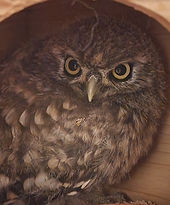
Little Owl
The Little owl Athene noctua
The little owl is not actually a native British species. The UK population is thought to have originated from large estates in Kent and Northampton after introductions in the 1870's from mainland Europe. However, it seems that they cause no negative effects on other species and have filled a vacant ecological niche. The little owl population is in decline in the UK, thought to be due to an increase in intensive farming (The Woodland Trust, 2026). Therefore, it important to help to conserve this species the best we can.
The little owl is the smallest owl in the UK and adults are often mistaken for baby owls due to their tiny height of only 20cm tall. They mostly eat small mammals and birds, and larger insects such as crickets and beetles. Little owls will often remain in the same breeding pair for life, building nests in small holes in trees or occasionally occupying disused rabbit burrows.
This individual was found as a young fledgling on a road and mistaken for a baby Tawny owl (Strix aluco). On arrival to the wildlife rescue it was found to be in great condition, with no injuries. The theory is that it had recently fledged the nest and struggled to find food during the heat wave. After some time in care, eating lots of food and a lot of flight practice, he was released back to a suitable location near to where he was found.
20% of all sales of this print and the original artwork will be donated to HART Wildlife Rescue

- The Mammal Society (2026) Feline the pressure: domestic cats and wildlife. Available at: Feline the pressure: domestic cats and wildlife — Mammal Society . (Accessed: 30 August 2026)
- The Woodland Trust (2026) Little owl. Available at: Little Owl (Athene noctua) - British Birds - Woodland Trust (Accessed: 31 August 2026)